Set up AI Defense
AI Defense is available only in Sophos Fusion accounts that have been upgraded to the new platform with Security Operations.
The first time you access AI Defense, an assistant guides you through the following steps of the setup process:
- Organization: Enter details of your organization so that we can tailor the setup experience for your needs.
- Sensors: Select the sensors which send data about AI activity to AI Defense. The sensors can include Sophos Endpoint, Sophos Firewall, and Linux servers protected by Sophos Protection for Linux.
- Endpoint: Check that your endpoints meet the requirements for using AI Defense. If any requirements are missing, follow the links to the settings you need.
- Firewall: Check that your firewalls are enrolled in groups and that you can see the group configuration. Follow the links to configure or confirm the settings.
- Server: Check that your Linux Servers are configured to upload network data to Sophos Fusion. Follow the link to configure or confirm the setting.
- Protection: Create your first policy. The policy controls which AI apps your users can use.
If a Sophos Partner has created a policy for you, you don't need to create one.
Note
If you need to run the assistant again in the future to update settings, go to Settings and click Restart onboarding.
To set up AI Defense, do as follows:
-
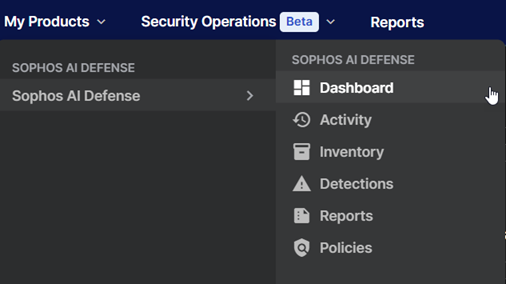
Go to My Products > Sophos AI Defense.
-
In Set up AI Defense, click Get started.
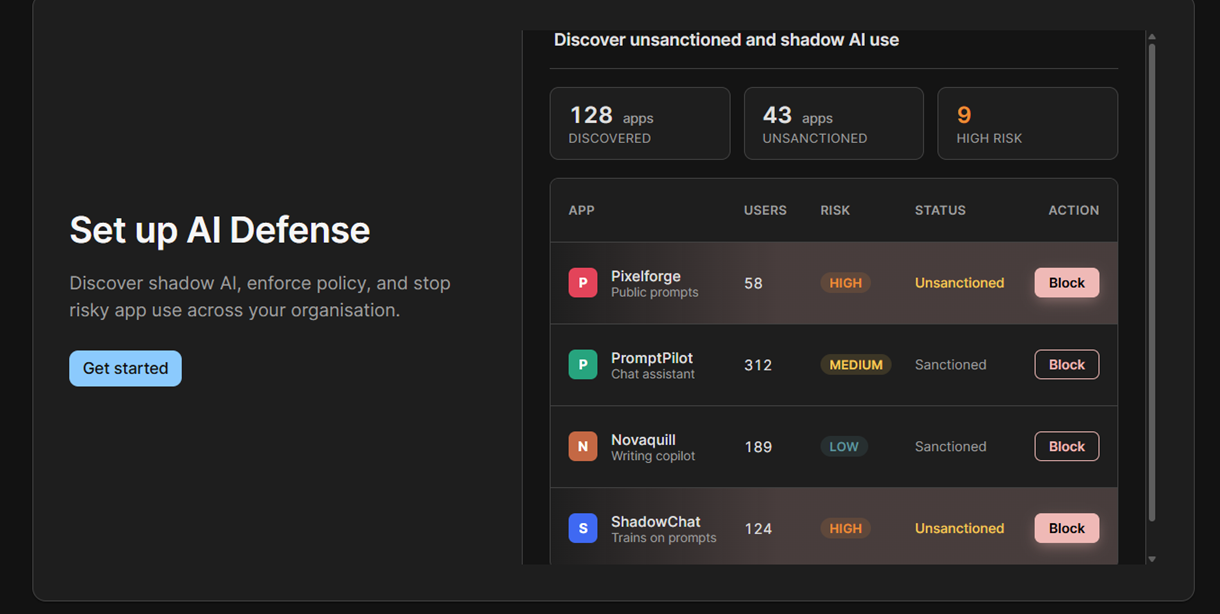
The Onboarding settings assistant starts.
Onboarding settings
The Onboarding settings assistant tailors the AI Defense setup to your organization and the sensors in your environment. It guides you through the required configuration for your endpoints, firewalls, and Linux servers. It also helps you create a base policy.
Organization
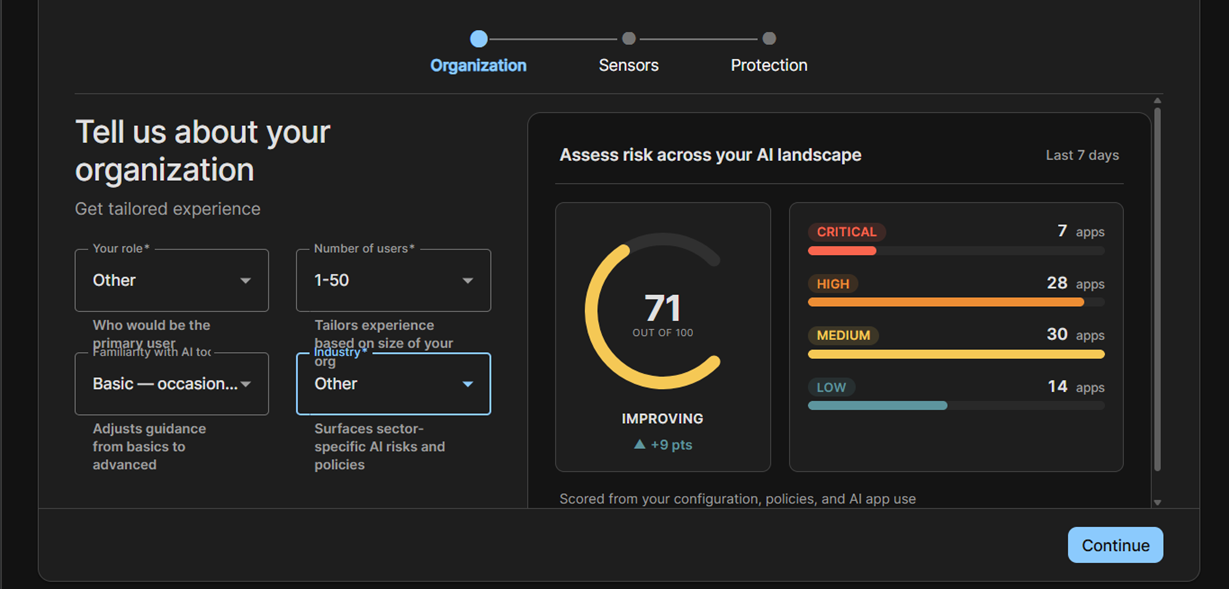
In Tell us about your organization, enter details of the administrator's role and familiarity with AI tools, the number of users, and the sector your organization is in. These details let us tailor AI Defense to your specific industry, knowledge, and risk level.
Sensors
AI Defense sensors are the devices that gather data about AI activity in your environment and send it to Sophos Fusion. You can then use this information to get a detailed picture of AI use in your environment and create AI Defense policies.
In Choose your sensors, select one or more of the following sensors:
- Sophos Endpoint: Provides device and user-level information and control for AI use on managed Windows and Mac devices.
- Sophos Firewall: Provides network telemetry about AI use for all managed and unmanaged devices behind the firewall.
- Sophos Linux Server: Provides endpoint-level visibility and control of AI use on your managed servers.
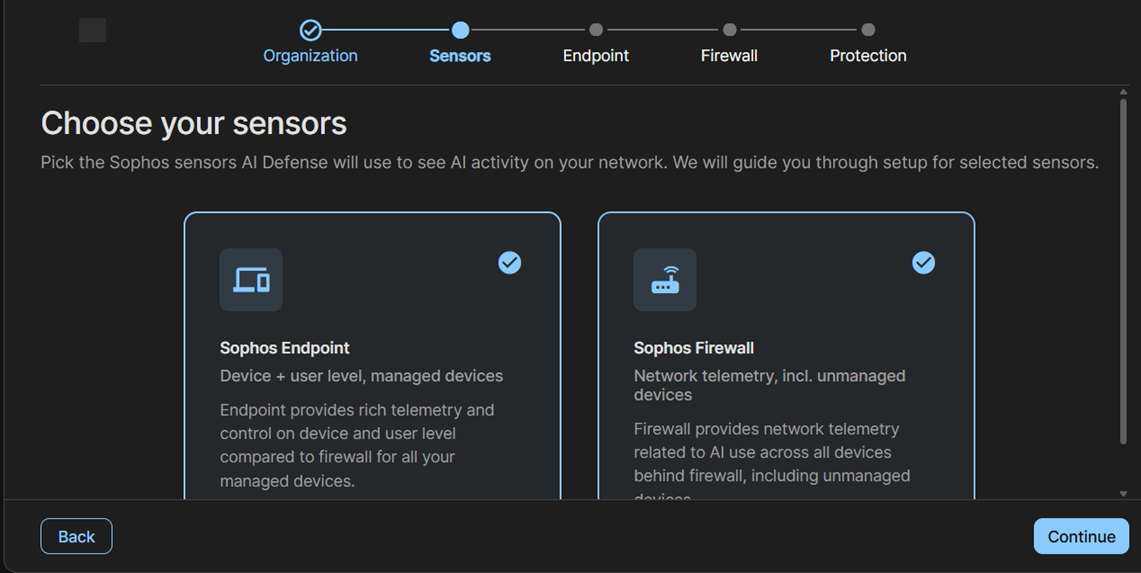
The next setup steps depend on the sensors you selected. In each step, you'll check that the sensor meets AI Defense requirements. Click Continue.
Note
AI Defense checks whether the selected sensors are available. If it can't verify their status, you see an error message. Click Refresh to check again. If the check fails again, you can still continue the setup process.
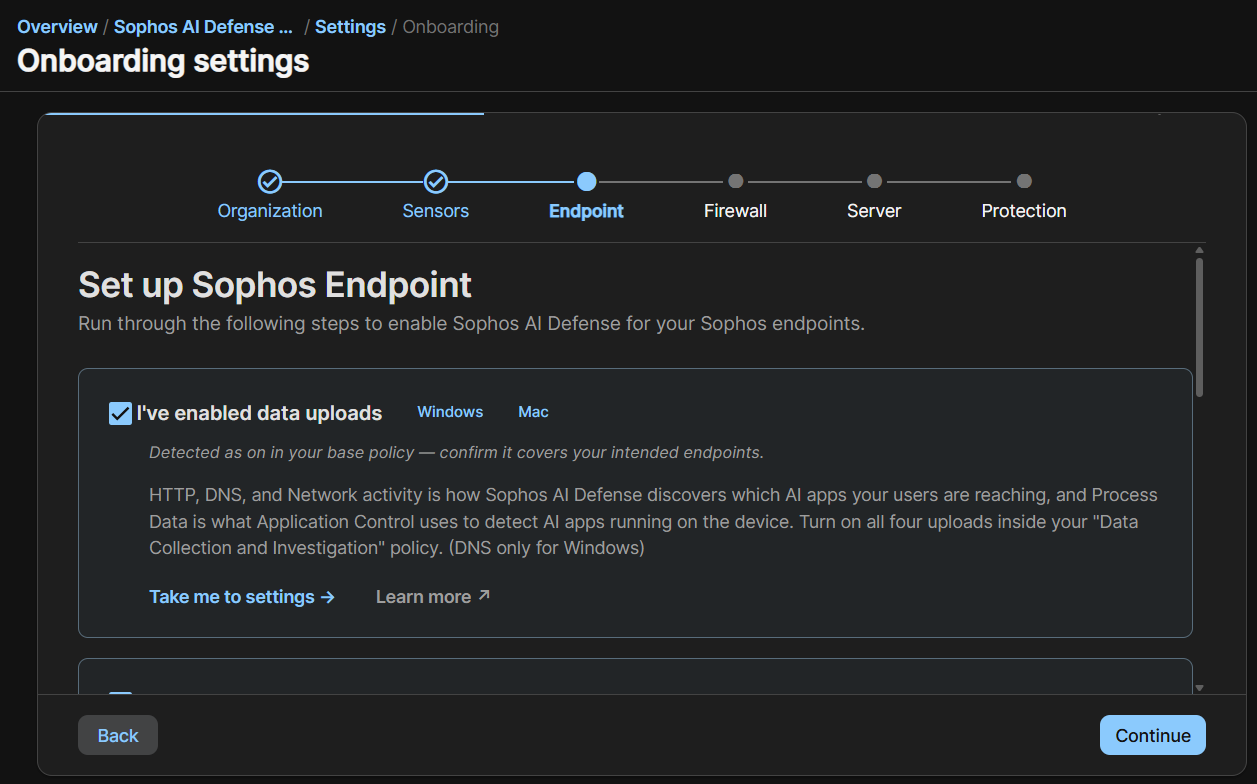
Endpoint
AI Defense endpoint setup requires you to make sure your environment is configured properly so that AI use can be detected within your environment and sent to Sophos Fusion. You must also configure the relevant policy settings so that AI Defense can add and enforce its rules on the endpoints.
In Set up Sophos Endpoint, the assistant prompts you to confirm that you've turned on settings. Select the checkbox next to each item to confirm it and to see the next item.
The settings to check or turn on are data uploads, TLS decryption, QUIC browser connections, web profiles, and application control policies. For each option, click Take me to settings to open the relevant Sophos Fusion page or Learn more to open its help.
Important
When configuring your endpoint sensors, make sure you check all Web Profile and Threat Protection, Web Control, and Application Control policies that apply to the endpoints you want AI Defense to protect.
Data uploads
AI Defense uses HTTPS, DNS, network activity, and process data to dectect AI use within your environment. Your endpoints must send this data to Sophos Fusion so that AI Defense can use it to create policies that protect your endpoints.
Click Take me to settings or go to Endpoint > Policies > Data Collection and Investigation and complete the following steps for all Data Collection and Investigation policies that apply to users and devices you want AI Defense to protect:
- Make sure Upload to the Data Lake is turned on,
- Make sure Process Data, HTTP Data, Network Data, and DNS Data are all selected.
- When you've checked all applicable policies, go back to AI Defense onboarding, and select I've enabled data uploads.
TLS decryption
Because modern AI apps use HTTPS to encrypt network traffic, AI Defense can't inspect the traffic to see the full URL path or upload and download sizes without decrypting it.
Click Take me to settings or go to Endpoint > Policies > Threat Protection and complete the following steps for all Threat Protection policies that apply to users and devices you want AI Defense to protect:
- Make sure SSL/TLS decryption of HTTPS websites is turned on.
- When you've checked all applicable policies, go back to AI Defense onboarding, and select I've enabled TLS decryption.
QUIC browser connections
Quick UDP Internet Connections (QUIC) lets browsers bypass the HTTP and TLS traffic that AI Defense inspects. To ensure all traffic is being inspected by AI Defense, you must block QUIC browser connections in your endpoint Threat Protection policies.
Click Take me to settings or go to Endpoint > Policies > Threat Protection and complete the following steps for all Threat Protection policies that apply to users and devices you want AI Defense to protect:
- Make sure Block QUIC browser connections is turned on.
- When you've checked all applicable policies, go back to AI Defense onboarding, and select I've blocked QUIC browser connections.
Web profile
Web profiles are how AI Defense enforces Allow, Warn, and Block rules on endpoints. You must create web profiles in Sophos Fusion and that endpoint web control policies are configured to use the web profiles, and not legacy web controls.
Go to Global Settings > Protection and Remediation > Web Settings > Web Filtering Profiles and create at least one web profile.
Tip
You don't have to use the same profile in every policy. You can create multiple profiles to apply to users and devices. Using multiple profiles and policies means AI Defense can apply different levels of control over the use of AI apps to meet the needs of different users and devices.
Go to Endpoint > Policies > Web Control and complete the following steps for all Web Control policies that apply to users and devices you want AI Defense to protect:
- Make sure Web Control is turned on and Web Profile is selected.
- Make sure Choose a web filtering profile is turned on and you've selected the web profile you created for AI Defense.
- When you've created profiles and checked all applicable policies, go back to AI Defense onboarding, and select I've created a web profile and switched my endpoint web policies to use it.
Application Control
AI Defense uses Application Control policies to control the use of AI apps that run on devices and may not be detected by web filtering, such as desktop assistants. To do this, your Application Control policies must be configured to detect these applications and block them.
Click Take me to settings or go to Endpoint > Policies > Application Control and complete the following steps for all Application Control policies that apply to users and devices you want AI Defense to protect:
- Make sure Detect controlled applications when users access them is turned on and Block the detected application is selected.
- When you've checked all applicable policies, go back to AI Defense onboarding, and select I've set my Application Control policy to block detected applications.
For full details, see Application Control Policy.
When you've confirmed all endpoint policies are configured properly, click Continue.
Firewall
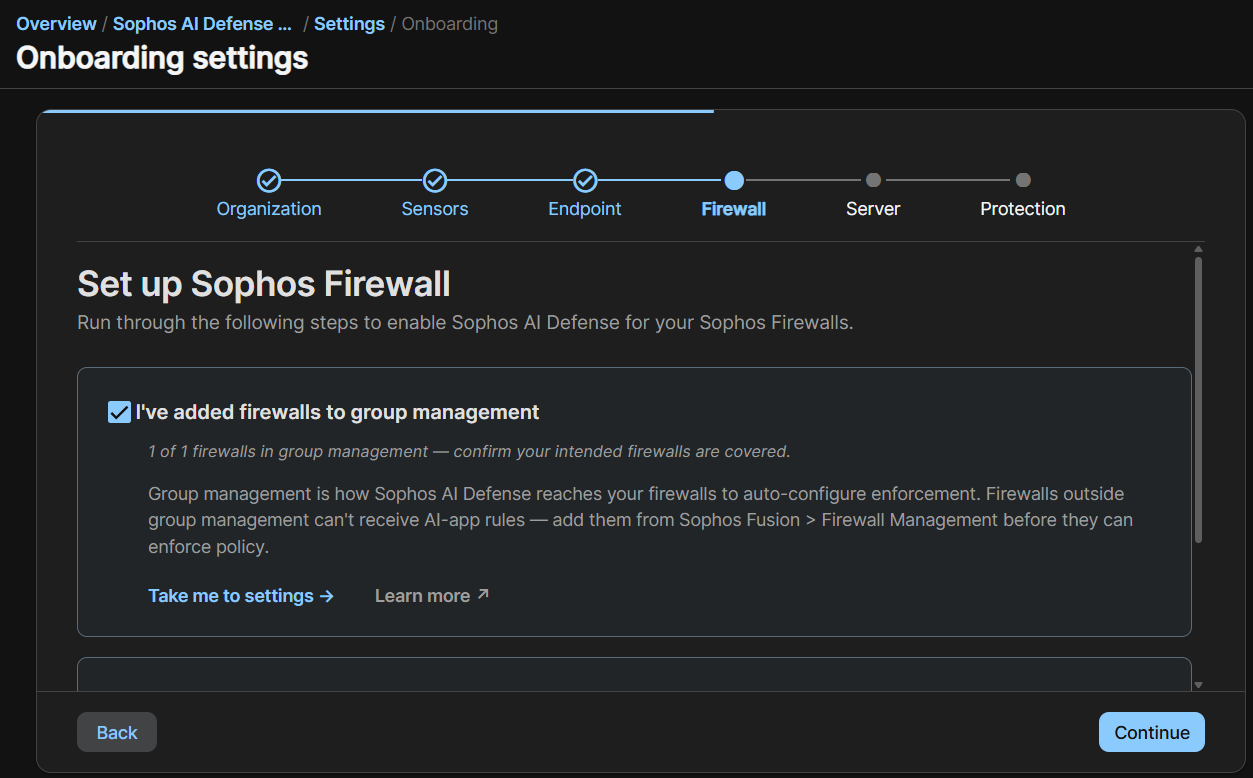
AI Defense firewall setup requires you to add your firewalls to groups in Sophos Fusion so that AI Defense can apply its rules to the web policies for those devices. You must also turn on logging for the firewall web policies so that AI Defense can identify AI activity from the firewall's web policy logs.
Firewall groups
Sophos AI Defense uses Firewall Group Management in Sophos Fusion to apply AI Defense rules to Sophos Firewall web policies. Before you can apply AI Defense rules to a firewall web policy, you must add the firewall to a firewall group and make its configuration available in Sophos Fusion. Firewalls outside Sophos Fusion group management can't receive AI Defense rules.
Make sure you've completed the following tasks for all firewalls to which you want to apply AI Defense rules before proceeding with AI Defense firewall setup:
- Add the firewalls to Sophos Fusion. See Add firewalls.
- Create Sophos Fusion firewall groups, add the firewalls to them, and import the existing firewall configuration where appropriate. See Firewall groups.
- Confirm that the web policies you want to use are available in the firewall group.
When you confirm these tasks are complete, go back to AI Defense onboarding, and select I've added firewalls to group management.
Web policy logging
AI Defense uses the web policy logs from firewalls to identify AI activity in your environment.
Click Take me to settings or go to Firewall Management > Firewalls and complete the following steps for all firewall groups that you want AI Defense to protect:
-
Click the three dots
 for the firewall or firewall group you want to configure. Then click Manage policy or Manage firewall to edit the group or firewall policy settings.
Tip
You can also click the name of the firewall or firewall group to manage the policy.
-
Click Web.
- Click the three dots
 for the web policy you want to configure, and click Edit.
-
Go to Advanced Settings and make sure Enable logging and reporting is selected.
AI Defense requires this logging to discover AI activity.
-
Click Save to save any changes you've made.
- When you've checked all applicable policies, go back to AI Defense onboarding, and select I've enabled logging in web policies.
When you've confirmed all firewall settings are configured properly, click Continue.
Server
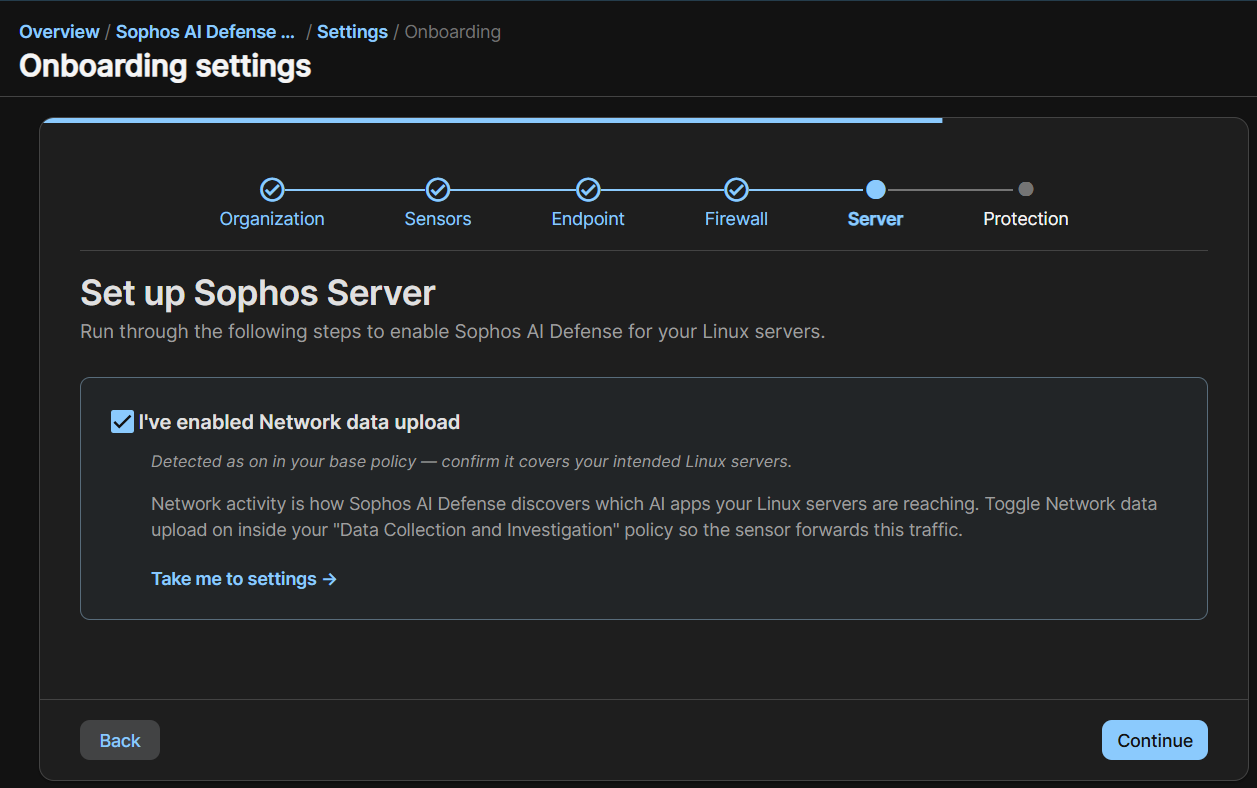
AI Defense identifies AI activity on your Linux servers by checking DNS lookups and the Server Name Indication (SNI) of HTTPS connections. You must configure your server policies to send this data to Sophos Fusion so that AI Defense can use it to create policies that protect your Linux servers.
Click Take me to settings or go to Server > Policies > Data Collection and Investigation and complete the following steps for all Data Collection and Investigation policies that apply to users and devices you want AI Defense to protect:
- Make sure Upload to the Data Lake is turned on,
- Make sure Network Data is selected.
- When you've checked all applicable policies, go back to AI Defense onboarding, and select I've enabled Network data uploads.
When you've confirmed all server policies are configured properly, click Continue.
Protection
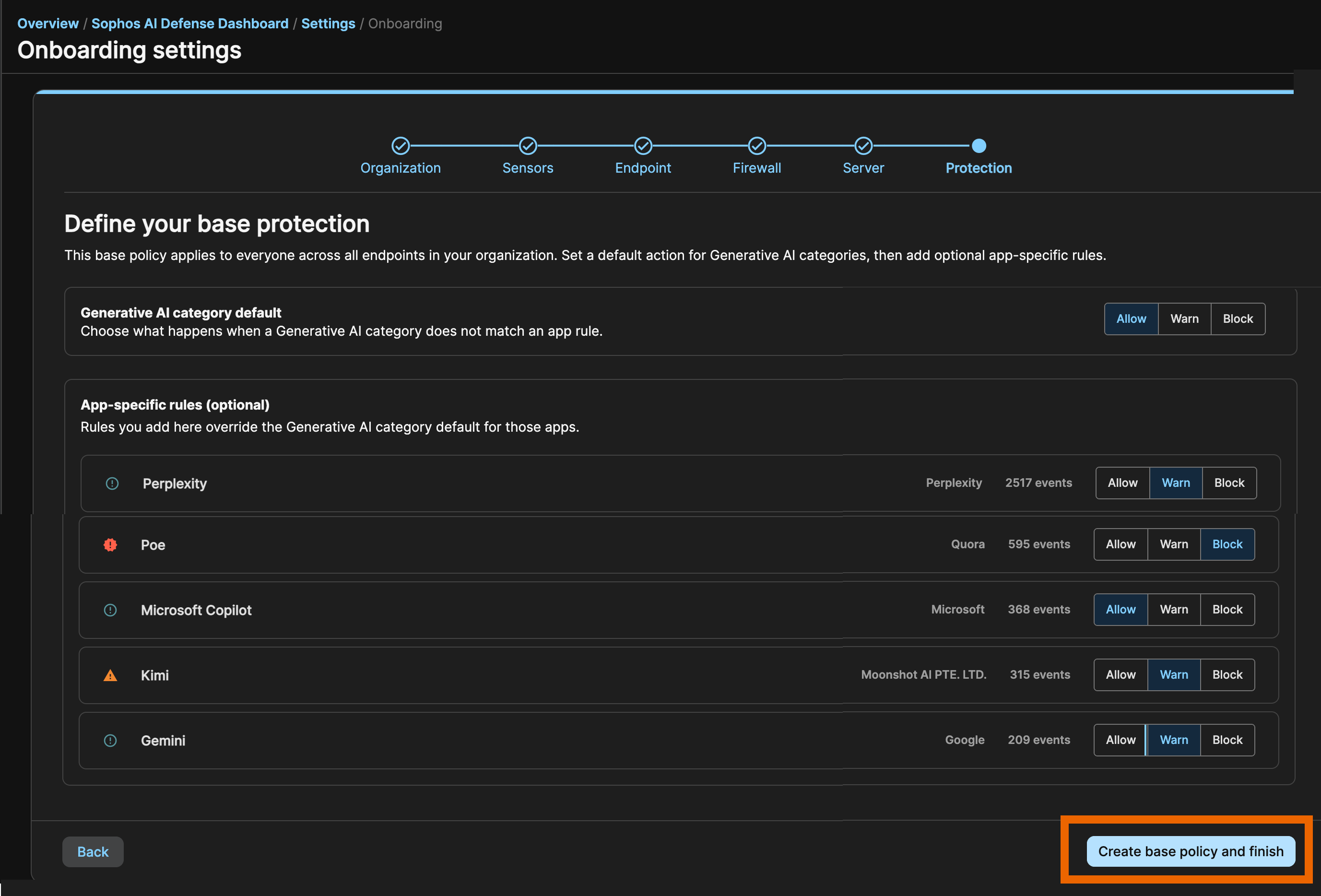
The Define your base protection page opens when you've completed the requirement checks for all your sensors. If there's no base policy yet, create one now. The base policy applies to everyone in your organization.
Note
If there's already a base policy, onboarding leaves it unchanged. Click Finish and take me to the policy.
To create a base policy, do as follows:
-
Set the Generative AI category default. This is the action AI Defense takes on any AI app that you haven't set a rule for. Select whether to block, warn about, or allow apps.
Any app-specific rule you set overrides this default.
-
(Optional) Set app-specific rules. The page shows you AI apps used in your organization in the past thirty days. Select whether to block, warn about, or allow each app.
-
Click Create base policy and finish. Alternatively, you can skip this step.
If you chose to create a base policy, its policy details page opens.
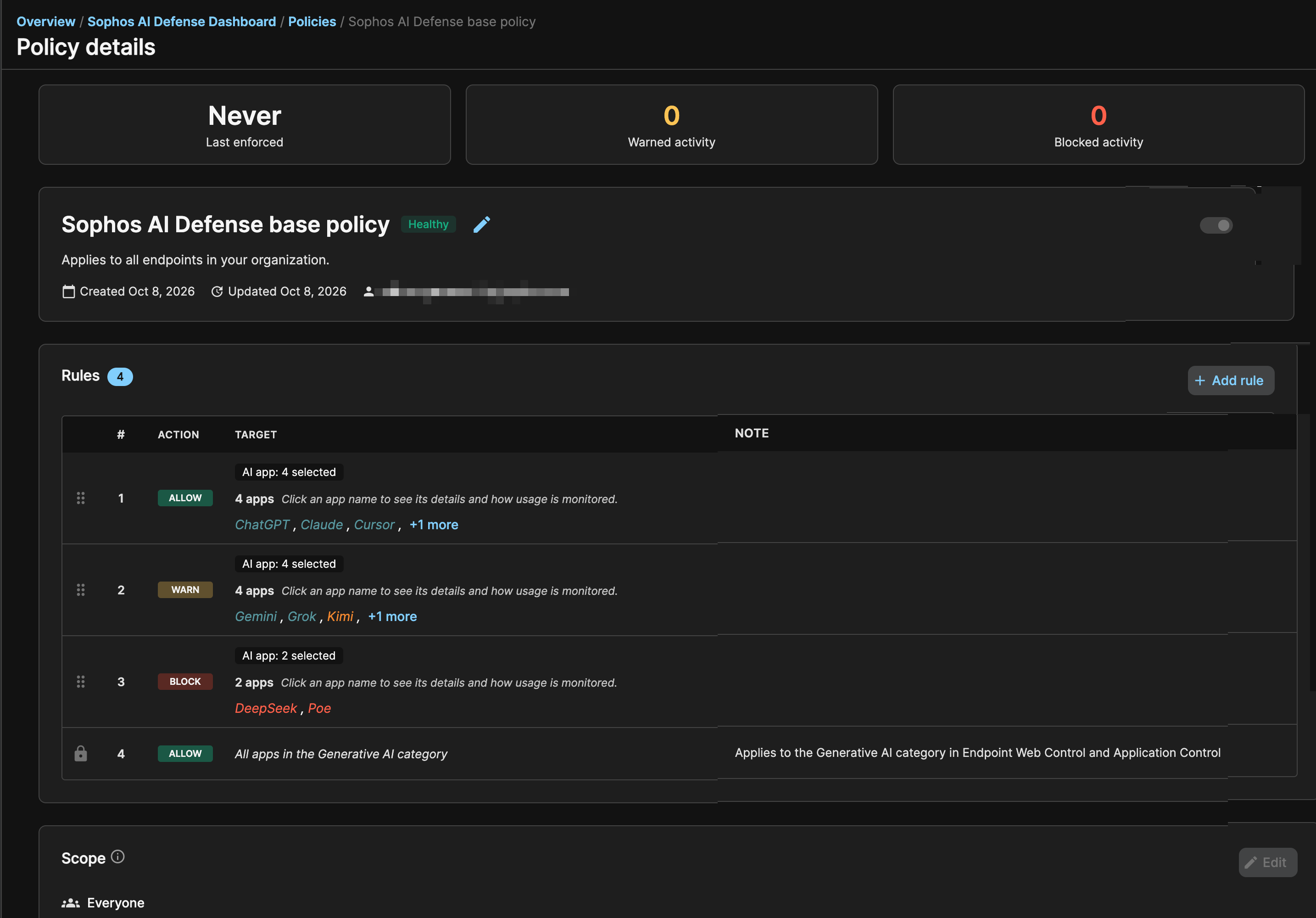
To find out how to create more policies and how policies are prioritized, see AI Defense policies.