AI Defense policies
Early Access Program
This product is currently in an Early Access Program (EAP). Register for the EAP.
AI Defense policies let you control which AI apps your users can access.
A policy consists of these settings:
- Rules, which specify which AI apps or app types will be allowed, blocked, or warned about.
- Scope, which specifies which users, groups, or networks the policy applies to.
View policies
To view policies, go to My Products > AI Defense and click Policies.
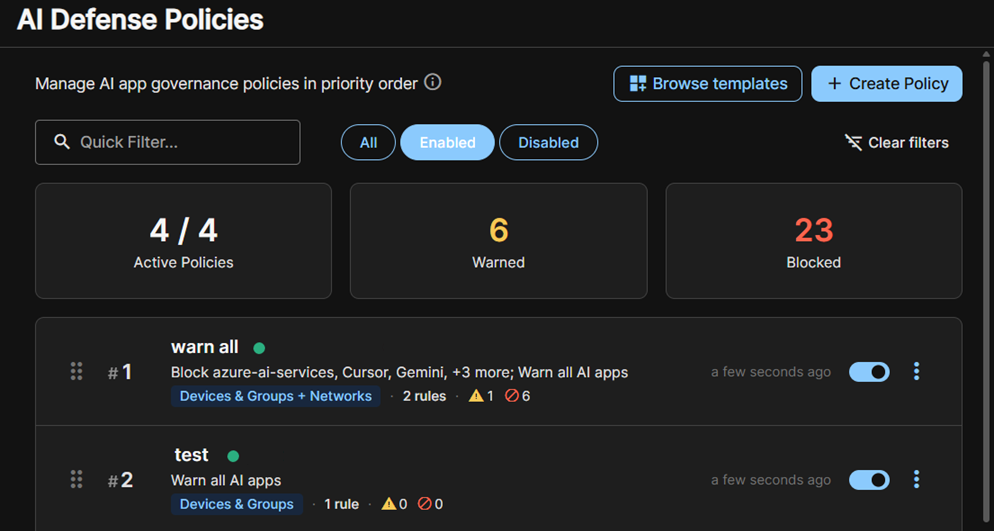
The widgets show the number of active policies and the number of AI activities that policies have blocked or warned about.
The policies list shows individual policies, indicates whether they apply to users, groups, or networks, and summarizes their block, allow, or warn rules.
How policies are applied
Policies at the top of the list have the highest priority.
AI Defense checks AI activities against each priority's rules, starting at the top. The first priority that matches an AI activity is applied to that activity.
Filter policies
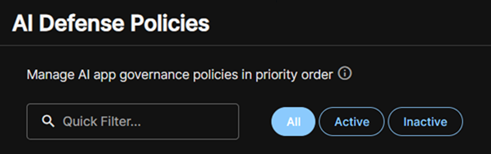
To filter policies by activity, click All, Active, or Inactive. The policies shown in the list and the statistics in the widgets change to reflect the filter you apply.
Alternatively, in Quick Filter, enter the name or partial name you want to filter the list by.
Create a policy
This section describes how to create a new policy. If you base your policy on a template or a cloned policy, some settings are already selected. See Create a policy from a template or Clone a policy.
- Go to My Products > AI Defense and click Policies.
-
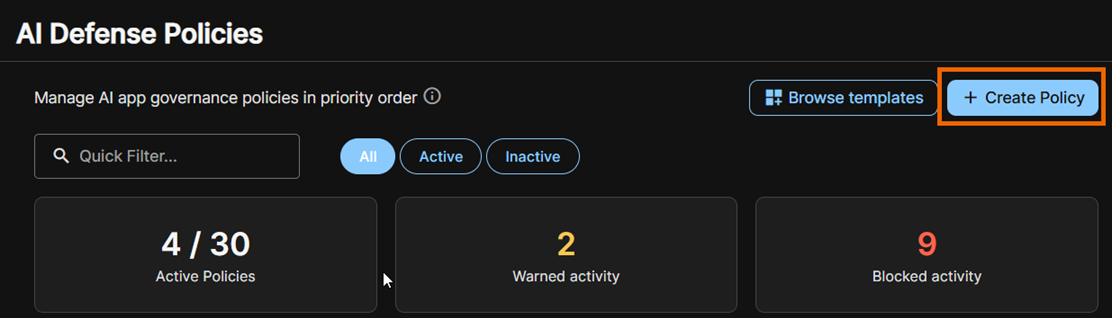
On the Policies page, click Create policy.
-
On the Create Policy page, in Policy Details, do as follows:
- Enter a policy name.
- (Optional) Enter a description of the policy.
Next, set the policy rules and scope. The scope specifies the users or devices it applies to.
Set rules
In Rules, you can create and edit rules.
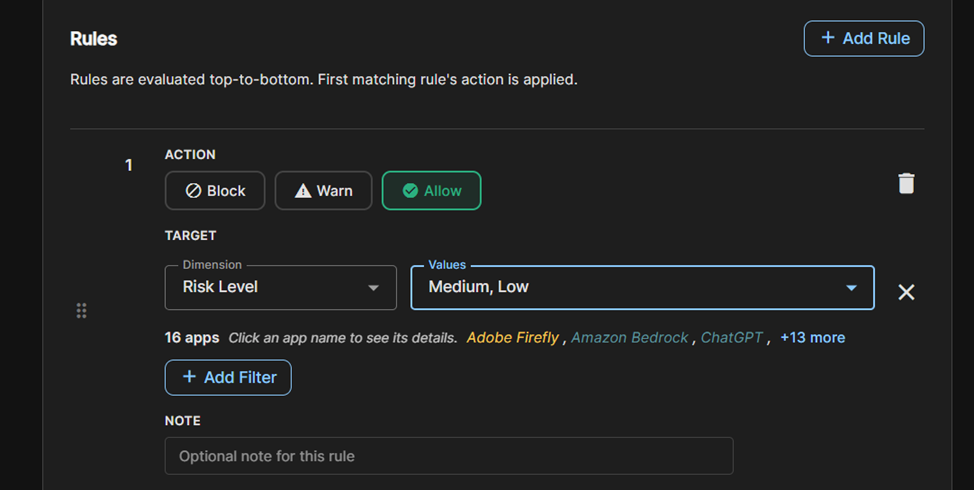
Rules at the top of the list have the highest priority. The first rule that matches an AI usage event applies to that event.
By default, there's a rule that blocks all AI apps. We recommend that you keep this rule at the bottom of the list and add rules that allow some AI apps above it. The default rule then blocks AI usage that doesn't match any of the other rules.
To create a new rule, do as follows:
- Click Add Rule.
-
Select the Action. This is the action we'll take when AI usage matches the rule.
We can block the AI app, allow it, or warn the user about its risks but let them use it.
-
Specify the Target as follows:
- Click Add Filter.
- Select a Dimension. This can be an AI characteristic, for example risk level or compliance with industry standards, or an application name.
-
Select a Value for that dimension. For example, Low or Medium for risk level.
If you selected Application as the dimension, click the Value field to see a list of apps. Select apps you want the rule to apply to.
-
Optional. Click Add Filter to specify another Dimension and Value pair.
Set the scope
In Scope, specify the users, groups, or networks the policy applies to.
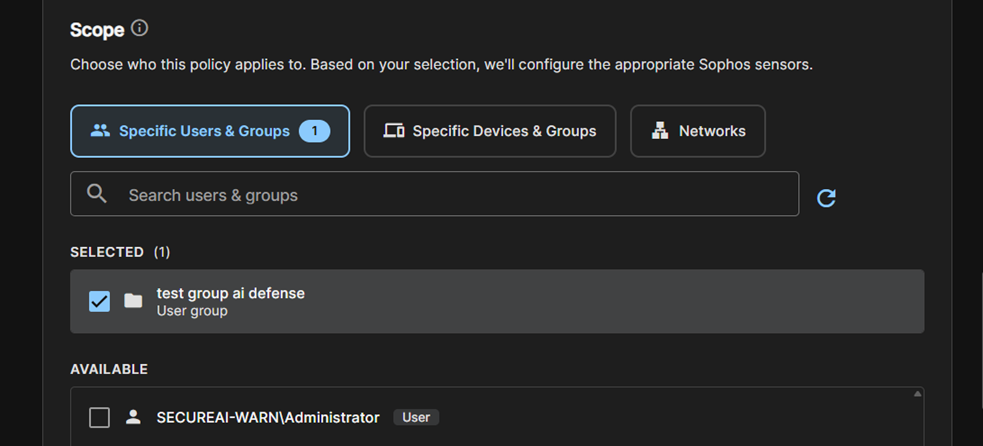
Set the scope as follows:
- Select who or what you want the policy to apply to. For example, click Specific Users and Groups.
-
Select items from the Available list. For example, select specific users or groups.
The page now shows which products the policy will apply to: Sophos Endpoint or Sophos Firewall.
-
Review your settings in What will happen.
- Select I've reviewed the rules and scope above.
-
Save your policy as follows:
-
Click Save to save the policy but not activate it. This lets you change its place in your list so that it has the priority you want before you activate it.
-
Click Save & Enable to activate the policy immediately with top priority.
-
Create a policy from a template
You can create a policy based on a Sophos template.
- Go to My Products > AI Defense and click Policies.
-
On the AI Defense Policies page, click Browse templates.

-
Select a template suitable for your industry. Each template is shown with a summary of its rules. Click Use.
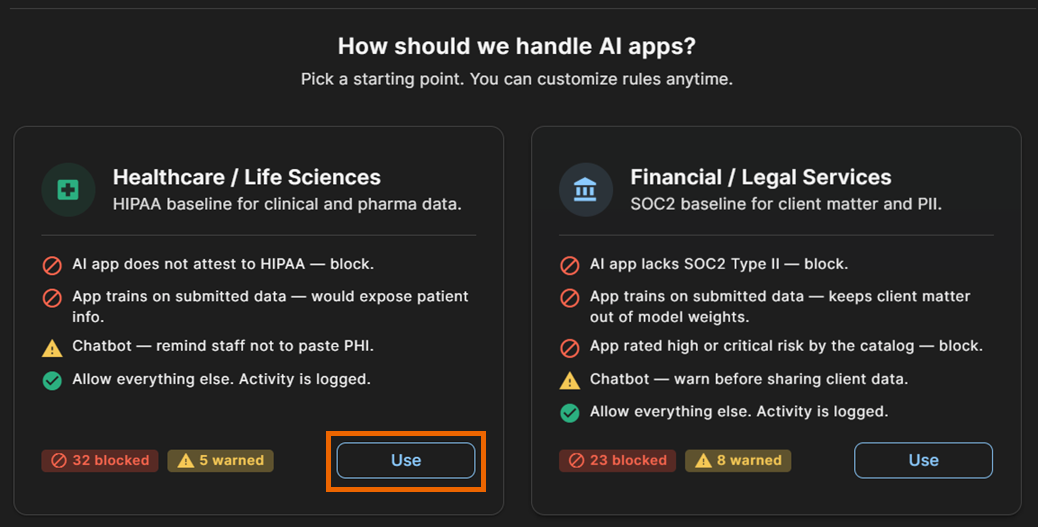
The Create Policy page opens with settings pre-filled.
-
To customize and save your policy, follow the steps in Create a policy.
Clone a policy
You can clone an existing policy and customize it for your needs.
- Go to My Products > AI Defense and click Policies.
- On the AI Defense Policies page, click the three dots
 next to a policy.
 -
Select Clone.
The Create Policy page opens, with the settings from the cloned policy pre-filled.
-
Re-name the policy, edit the settings, and save your policy. For details, see Create a policy.
Edit a policy
To edit a policy, do as follows:
- Go to My Products > AI Defense and click Policies.
-
Click the policy's entry in the list to open its details page.
In Rules, you can make changes as follows:
- To add another rule, click Add Rule.
- To change a rule, click the Edit icon
 next to the rule, update the settings, and click Save Rule.
In Scope, click Edit and change the resources the policy will apply to.